Walk into any corporate marketing department, and you will likely find a fascinating divide. On one side of the room sits a veteran strategist with a pristine Master’s degree in marketing from an elite university. On the other side sits a 23-year-old high school dropout who is currently managing a $50,000-a-month ad budget and pulling in a 4x return on investment.
This is the reality of the modern advertising landscape, and it highlights a massive industry secret: The Myth of the Marketing Degree: Real Digital Marketing Qualifications Explained isn’t about discarding education entirely, but about realizing that traditional textbooks simply cannot keep pace with the speed of the internet.
If you are trying to break into the industry, relying solely on a four-year degree is a dangerous gamble. Let’s dismantle the myth of the marketing degree and look at the real digital marketing qualifications you need to get hired, get clients, and actually drive business growth today.
Table of Contents
Why Traditional Marketing Degrees are Broken
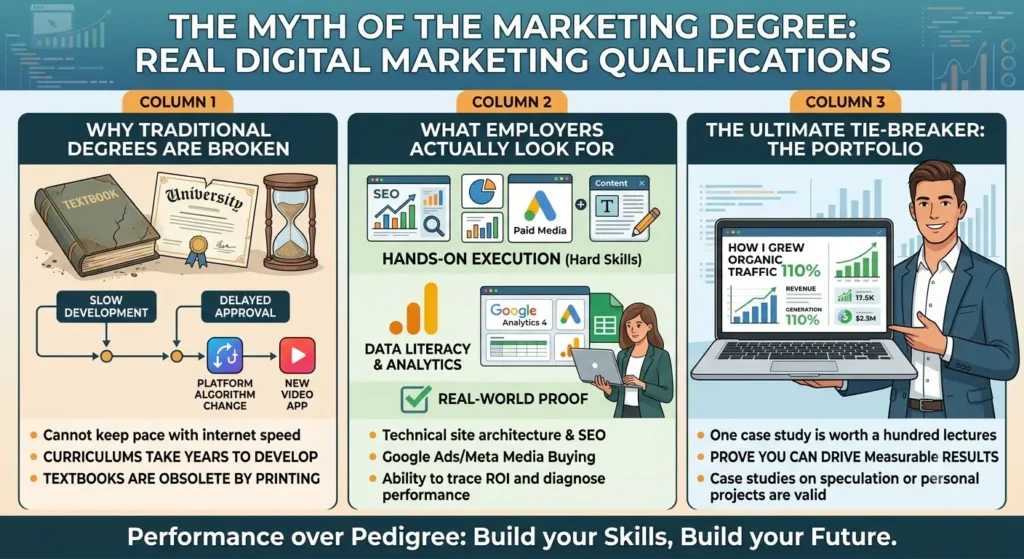
To understand why the traditional degree is losing its grip, you only have to look at how fast the digital world moves. A university curriculum takes years to develop, approve, and implement. By the time a textbook chapter on social media advertising is printed, the platform’s algorithm has already changed three times, a new privacy regulation has rolled out, and a brand-new video app has taken over the world.
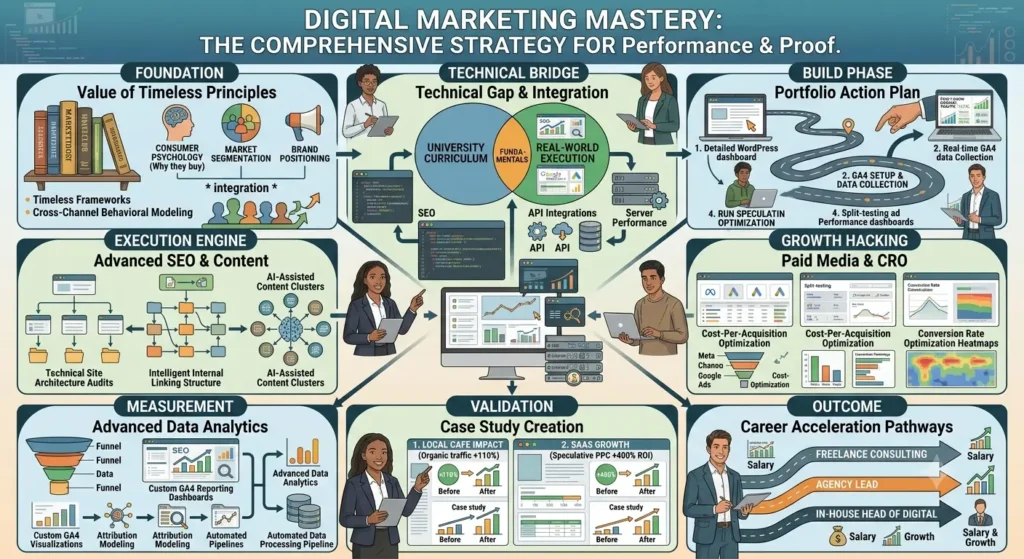
Traditional degrees are excellent for teaching timeless foundational concepts:
- Consumer Psychology: Understanding why people buy.
- Market Segmentation: Breaking down a massive audience into targetable groups.
- Brand Positioning: Figuring out how a company stands out from competitors.
But when it comes to the technical execution—the exact skills companies are actively paying for—universities fall short. A degree won’t teach you how to write an email automation sequence that converts abandoned carts, nor will it show you how to structure an ad account to survive data privacy updates.
Because of this gap, relying on an academic credential is the core flaw behind The Myth of the Marketing Degree: Real Digital Marketing Qualifications Explained. Employers no longer care what you memorized for a midterm; they care about what you can execute on Monday morning.
FOR DETAILS CONTACT VV DIGITAL
The Real Digital Marketing Qualifications Employers Look For
If hiring managers aren’t looking at the university line on your resume, what are they looking for? The true qualifications of a modern marketer come down to three distinct pillars: verifiable technical skills, data competency, and real-world proof.
1. Hands-On Execution (The Hard Skills)
You need to show that you understand how to navigate the platforms where modern business happens.
- Search Engine Optimization (SEO): This isn’t just about writing blog posts. It’s about technical site architecture, executing a strategic internal link strategy to pass authority between pages, and understanding search intent.
- Paid Media (PPC): Knowing how to properly allocate a budget on Google Ads or Meta. You must understand audience targeting, dynamic creative optimization, and how to maintain a profitable Cost Per Acquisition (CPA).
- Content & Copywriting: The ability to write words that move people to action. Whether it’s a short-form video script or an in-depth guide, great copy is the engine of all digital campaigns.
2. Data Literacy and Analytics
Creativity without data is just a hobby. A truly qualified digital marketer must be obsessed with tracking and measurement.
You need to know your way around tools like Google Analytics 4 (GA4) and CRM platforms. If you cannot look at a spreadsheet of traffic data, diagnose why conversions dropped by 15% last week, and formulate a plan to fix it, you lack the core qualification of the job.
3. The Ultimate Qualification: The Portfolio
The ultimate tie-breaker in any job interview or client pitch is a portfolio of real work.
The Portfolio Rule: One single case study showing how you built a website, grew an organic audience, or ran an ad campaign that generated actual revenue is worth more than a hundred university lectures.
Certifications vs. Degrees: A Better Alternative?
If a degree isn’t the answer, are online certifications the magic bullet? Yes and no.
Certifications from credible institutions are highly valuable because they prove you have a baseline understanding of specific, modern software tools. They show a hiring manager that you have the initiative to learn on your own time.
If you want to build a resume that gets noticed, skip the expensive, unverified bootcamps and focus on obtaining industry-standard, free credentials directly from the platforms themselves:
- Google Skillshop: For Google Ads and Google Analytics certifications.
- HubSpot Academy: Excellent for inbound marketing, content strategy, and email marketing.
- Meta Blueprint: The gold standard for proving you know how to run Facebook and Instagram ads.
- However, remember that a certification is still just a piece of paper. The real value comes when you take the knowledge from that certificate and apply it to a project of your own.
- How to Build Real Qualifications from Scratch
- If you have no degree and no corporate experience, you can still build a world-class marketing resume in a matter of months by treating yourself as your very first client.
- 1.Build a digital asset:Weeks 1-3.
- Launch a self-hosted WordPress website or a dedicated niche social media channel. Pick a topic you are genuinely interested in—whether it’s fitness, local food, or personal finance.
- 2.Drive organic traffic:Weeks 4-8.
- Apply SEO principles. Write high-quality content, optimize your on-page elements, and build an intentional internal link structure to keep users on your site longer.
- 3.Set up analytics:Ongoing.
- Install Google Analytics and Google Tag Manager. Learn to track your traffic, see where users are dropping off, and analyze which pieces of content perform best.
- 4.Document your results:The Final Step.
- Turn your project into a case study. Even if you only grew the site to 1,000 monthly visitors, documenting how you did it, what data you analyzed, and how you pivoted when things failed becomes your official, undeniable qualification.
- Conclusion
- When we pull back the curtain on The Myth of the Marketing Degree: Real Digital Marketing Qualifications Explained, the takeaway is incredibly empowering: the keys to this industry have been democratized. The internet has leveled the playing field entirely.
- The market doesn’t care about your pedigree; it cares about your performance. By focusing on practical technical execution, data literacy, and building a portfolio of real-world results, you can bypass the traditional gatekeepers and build a highly profitable, deeply rewarding career in digital marketing entirely on your own terms.
- Frequently Asked Questions
- Do digital marketing agencies require a degree?
- While some traditional or enterprise-level agencies still list a degree as a requirement to clear corporate human resource filters, the vast majority of modern digital agencies care far more about your portfolio, certifications, and technical problem-solving abilities during the interview process.
- Can I teach myself digital marketing for free?
- Absolutely. The vast majority of top-tier digital marketers are entirely self-taught. Between free platforms like YouTube, HubSpot Academy, Google Skillshop, and high-quality industry blogs, all of the technical knowledge you need to succeed is available online for free.
- What is the highest-paying skill in digital marketing?
- Skills directly tied to immediate revenue generation generally command the highest salaries and freelance rates. This includes Paid Media Management (Media Buying), Data Analytics/Conversion Rate Optimization (CRO), and high-level Direct-Response Copywriting.
- Is digital marketing oversaturated?
- The market is saturated with people who only have surface-level knowledge or generic certifications. However, there remains a massive shortage of high-level talent—marketers who truly understand deep data analysis, complex technical SEO, and business strategy. If you build real skills, you will stand out easily.