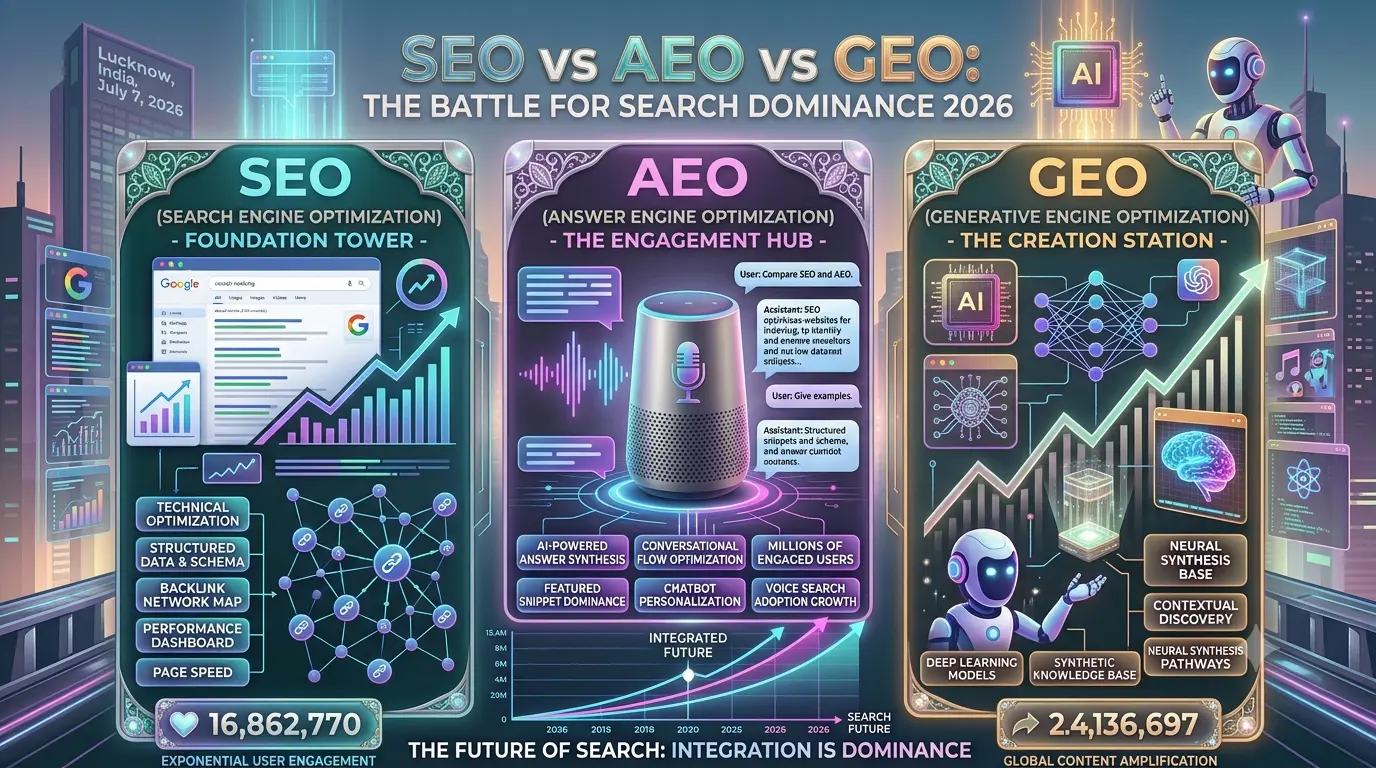
The way people search for information online has changed dramatically over the last few years. Traditional search engines like Google are no longer the only source users rely on. AI-powered search assistants, voice search, and generative AI platforms are transforming how people discover content.
Businesses that once focused only on Search Engine Optimization (SEO) must now understand Answer Engine Optimization (AEO) and Generative Engine Optimization (GEO). These three strategies are shaping the future of digital visibility.
But the biggest question remains:
Table of Contents
Which strategy will dominate search in 2026—SEO, AEO, or GEO?
The answer isn’t as simple as choosing one over another. Each plays a unique role in helping businesses reach their audience. In this guide, you’ll learn the differences, advantages, and how to build a winning search strategy for 2026 and beyond.
What is SEO?
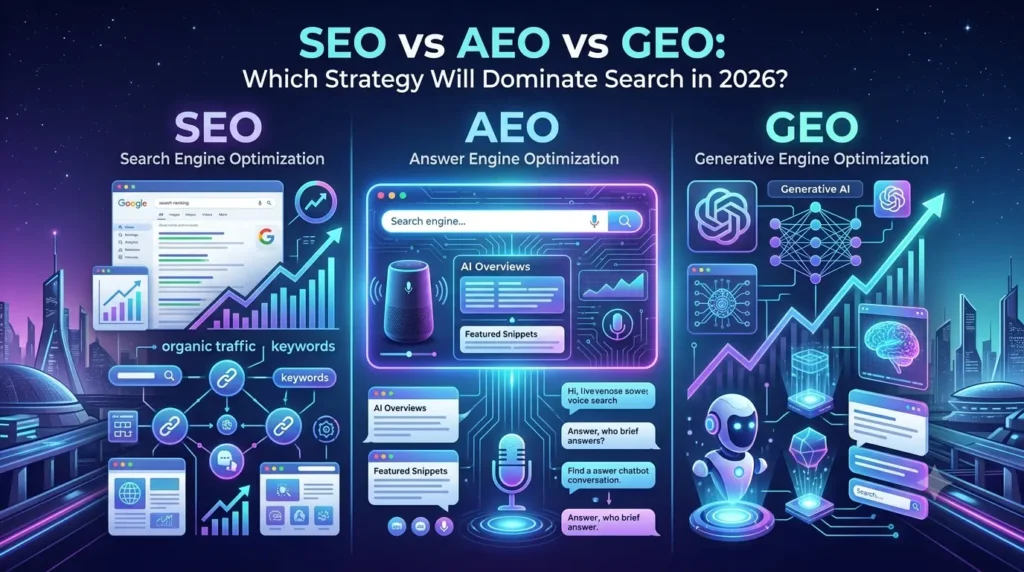
SEO (Search Engine Optimization) is the process of optimizing a website so it ranks higher on search engines like Google and Bing. The goal is to increase organic traffic by making your website relevant, authoritative, and user-friendly.
SEO focuses on improving your website’s visibility through keyword research, quality content, technical improvements, and backlinks.
Benefits of SEO
- Drives long-term organic traffic
- Builds trust and credibility
- Improves user experience
- Generates qualified leads
- Reduces dependency on paid advertising
- Increases brand awareness
Types of SEO
1. On-Page SEO
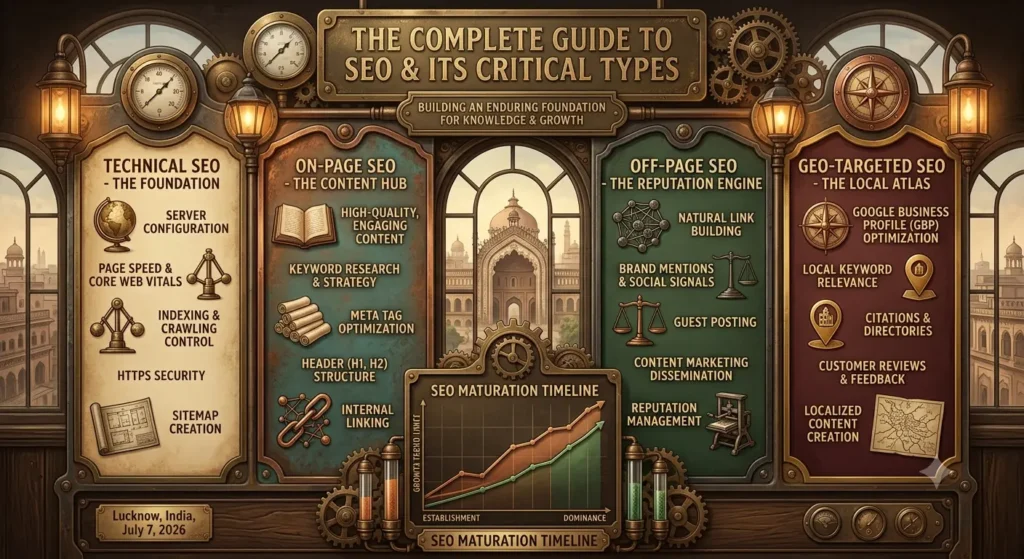
On-Page SEO refers to optimizing individual pages on your website.
Key elements include:
- Keyword optimization
- Meta titles
- Meta descriptions
- Header tags (H1-H6)
- Image optimization
- Internal linking
- Content quality
- URL structure
Example:
Primary Keyword:
SEO vs AEO vs GEO
Secondary Keywords:
- Search Engine Optimization
- Answer Engine Optimization
- Generative Engine Optimization
- AI SEO
- Types of SEO
2. Off-Page SEO
Off-Page SEO focuses on building your website’s authority.
It includes:
- Backlinks
- Brand mentions
- Guest posting
- Digital PR
- Social media sharing
- Influencer outreach
The higher the authority of websites linking to you, the better your chances of ranking.
3. Technical SEO
Technical SEO ensures search engines can crawl and index your website efficiently.
Important factors include:
- Website speed
- Mobile responsiveness
- HTTPS security
- XML Sitemap
- Robots.txt
- Core Web Vitals
- Schema Markup
- Canonical URLs
4. Local SEO
Local SEO helps businesses appear in location-based searches.
Examples:
- Digital Marketing Agency in Mumbai
- Best SEO Company Near Me
- Website Development Company Delhi
Local SEO includes:
- Google Business Profile optimization
- Local citations
- Reviews
- NAP consistency
- Local keywords
What is AEO?
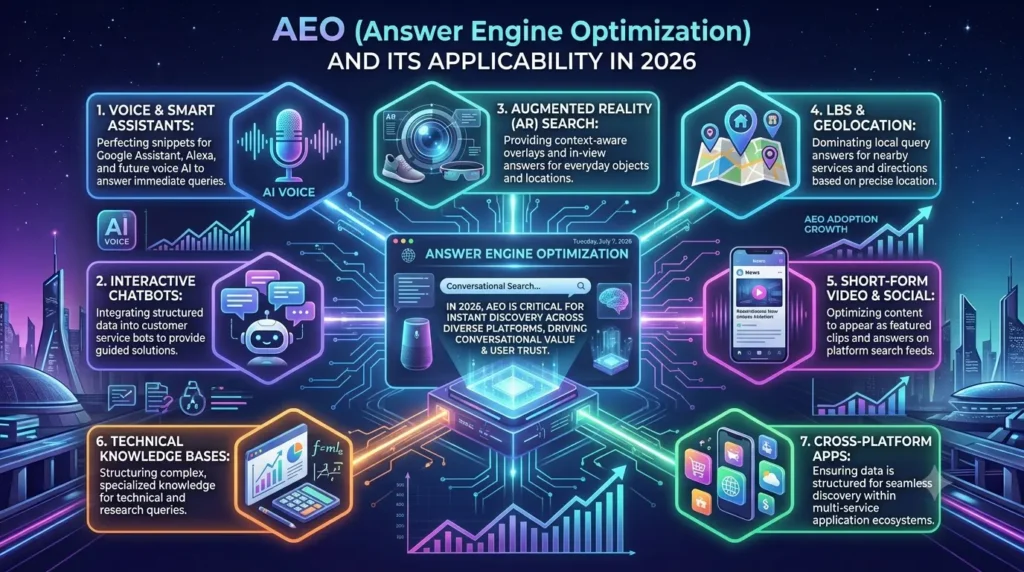
Answer Engine Optimization (AEO) is the practice of optimizing content so that AI assistants and search engines can provide direct answers to users.
Instead of showing ten blue links, Google increasingly displays featured snippets, People Also Ask boxes, AI Overviews, and voice search answers.
AEO focuses on becoming the answer, not just another search result.
Why AEO Matters
Modern users ask questions like:
- What is SEO?
- Which is better SEO or GEO?
- How does AEO work?
- What is Technical SEO?
Search engines now prioritize concise, accurate, and well-structured answers.
Best Practices for AEO
- Write question-based headings
- Add FAQ sections
- Use schema markup
- Create concise answers
- Use bullet points
- Optimize for voice search
- Build topical authority
What is GEO?
Generative Engine Optimization (GEO) is the process of optimizing content for AI-powered search engines and generative AI platforms.
Instead of simply ranking webpages, AI platforms generate responses by combining information from trusted sources.
Examples include AI-powered search experiences that summarize information and recommend brands directly in conversational answers.
GEO ensures your content is structured, authoritative, factual, and easy for AI systems to understand and reference.
Why GEO is Important
As AI becomes more integrated into search, users increasingly expect instant, conversational answers rather than scrolling through multiple pages.
Businesses that optimize only for traditional search may miss opportunities to appear in AI-generated responses.
SEO vs AEO vs GEO
| Feature | SEO | AEO | GEO |
|---|---|---|---|
| Focus | Search rankings | Direct answers | AI-generated responses |
| Platform | Google, Bing | Voice search, AI Overviews | Generative AI platforms |
| Goal | Website traffic | Instant answers | AI visibility |
| Content Style | Comprehensive | Question-based | Context-rich and authoritative |
| Optimization | Keywords & backlinks | FAQs & structured data | Entity-rich, trustworthy content |
| Future Importance | Very High | High | Rapidly Growing |
Which Strategy is Better in 2026?
The simple answer is none of them alone.
The strongest digital marketing strategy combines all three.
Choose SEO if:
- You want sustainable organic traffic.
- You want to rank for competitive keywords.
- You need long-term website growth.
Choose AEO if:
- You want to appear in featured snippets.
- You want to optimize for voice search.
- You want visibility in AI Overviews.
Choose GEO if:
- You want your brand mentioned by AI assistants.
- You want to prepare for the future of search.
- You want to increase visibility in conversational AI experiences.
The Best Strategy: Combine SEO + AEO + GEO
Rather than replacing SEO, AEO and GEO build upon it.
An effective content strategy should:
- Start with keyword research.
- Create high-quality, original content.
- Answer user questions clearly.
- Add structured data (Schema).
- Build topical authority.
- Earn high-quality backlinks.
- Keep information accurate and up to date.
- Use natural language that AI systems can easily interpret.
This integrated approach improves your chances of appearing in traditional search results, featured snippets, AI Overviews, and generative AI responses.
Best Practices to Win Search in 2026
- Publish in-depth, helpful content.
- Update articles regularly.
- Improve Core Web Vitals.
- Use descriptive headings.
- Optimize images with alt text.
- Link related articles internally.
- Cite credible external sources.
- Demonstrate expertise and trustworthiness.
- Focus on user intent rather than keyword density.
- Write for humans first, search engines second.
Internal Linking Suggestions
To strengthen your website’s SEO, link this article to related content such as:
- Digital Marketing Services
- On-Page SEO Checklist
- Technical SEO Guide
- Local SEO Services
- Content Marketing Strategy
- Website Development Services
- PPC Advertising Guide
- Social Media Marketing
These internal links help users discover more content and improve your site’s crawlability.
External Linking Suggestions
Include links to authoritative resources for additional credibility:
- Google Search Central Documentation
- Google Search Quality Evaluator Guidelines
- Google PageSpeed Insights
- Bing Webmaster Guidelines
- Schema.org
Referencing trusted sources reinforces the reliability of your content.
Common Mistakes to Avoid
- Keyword stuffing
- Publishing thin or duplicate content
- Ignoring mobile optimization
- Neglecting technical SEO
- Failing to update outdated articles
- Using poor internal linking
- Overlooking structured data
- Writing only for algorithms instead of people
Avoiding these mistakes helps maintain strong search performance across traditional and AI-driven search experiences.
The Future of Search
Search is evolving from keyword matching to understanding intent and context.
Users now expect fast, conversational, and accurate answers. Search engines and AI systems reward content that demonstrates expertise, solves real problems, and provides trustworthy information.
Businesses that invest in SEO while embracing AEO and GEO will be better positioned to reach audiences wherever they search—whether through a search engine, voice assistant, or AI chatbot.
Conclusion
The debate over SEO vs AEO vs GEO isn’t about choosing a single winner. SEO remains the foundation of online visibility, AEO enhances your chances of being the direct answer, and GEO prepares your brand for the growing influence of generative AI.
In 2026, the businesses that succeed will combine these strategies into one cohesive approach. By creating valuable, well-structured, and authoritative content, you’ll improve your visibility across search engines and AI-powered platforms alike.
If you want to future-proof your digital marketing efforts, start optimizing for all three today.
Frequently Asked Questions (FAQs)
1. What is the difference between SEO, AEO, and GEO?
SEO focuses on improving search engine rankings, AEO optimizes content for direct answers in search results, and GEO helps content appear in AI-generated responses.
2. Is SEO still relevant in 2026?
Yes. SEO remains the foundation of digital marketing and continues to drive valuable organic traffic.
3. What is AEO?
Answer Engine Optimization (AEO) is the process of optimizing content to appear as direct answers in search features such as featured snippets, AI Overviews, and voice search.
4. What is GEO?
Generative Engine Optimization (GEO) is the practice of creating content that AI-powered search and generative systems can understand, trust, and reference in their responses.
5. Can SEO, AEO, and GEO work together?
Absolutely. Combining all three strategies provides the best opportunity to gain visibility across traditional search engines and AI-driven search experiences.
6. Which strategy should small businesses prioritize?
Small businesses should build a strong SEO foundation first, then expand into AEO and GEO as part of a long-term content strategy.
7. Does keyword research still matter?
Yes. Understanding user intent and targeting relevant keywords remains essential, even as AI-powered search becomes more prominent.
8. How often should I update my SEO content?
Review and update important articles every three to six months to ensure they remain accurate, relevant, and competitive.