
The world of online business moves fast. If you are still relying on spreadsheets, manual email chains, and guesswork to find your audience, you are running a race with weights tied to your ankles. Today, success is determined by speed, precision, and efficiency.
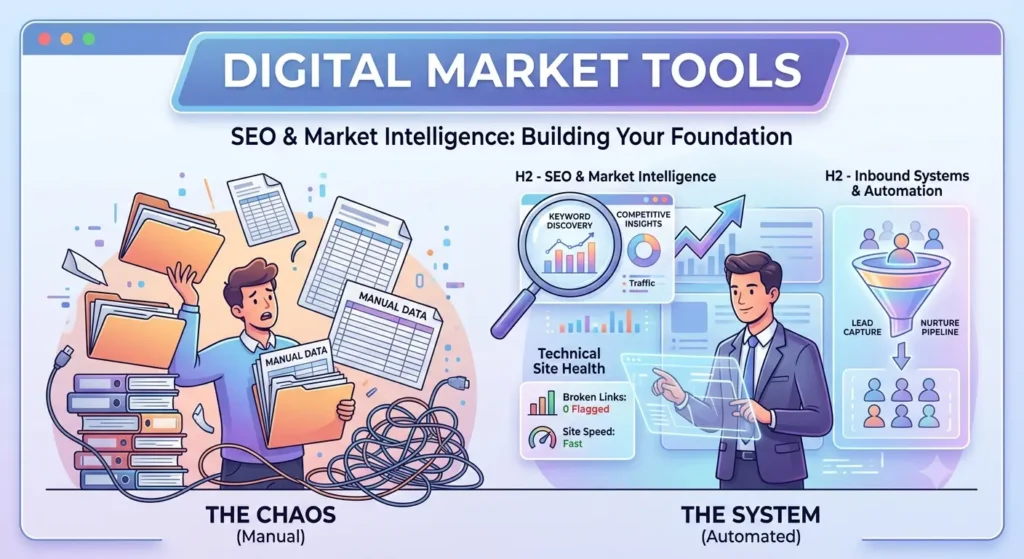
To scale efficiently, businesses must rely on modern software to handle everything from search engine visibility to automated customer communication. Choosing the right digital market tools is no longer just an administrative upgrade; it is the core foundation of any profitable modern business strategy.
Whether you are a solo freelancer trying to save time or an enterprise marketing team managing complex multichannel campaigns, finding the right software stack is crucial. Let’s break down the essential toolkits that can transform your business workflows from chaotic to automated.
Table of Contents
1. Search Engine Optimization (SEO) & Market Intelligence
Visibility is the ultimate currency on the internet. If your ideal customers cannot find you on Google, your product might as well not exist. This is where advanced SEO and search data systems become vital.
Technical Site Health and Keyword Discovery
Understanding what your audience is searching for requires more than a simple hunch. Platforms like Semrush and Ahrefs allow you to plug in a basic seed phrase and generate thousands of secondary keywords, search volume trends, and structural competitive insights. These platforms don’t just find words; they show you the exact search intent behind them, allowing you to build a content strategy around what users actually want to read.

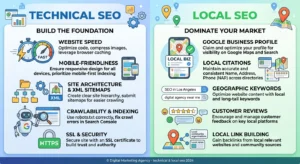
Beyond finding phrases, these platforms crawl your website like a search engine spider. They immediately flag technical errors such as:
- Broken links and 404 crawl errors
- Missing metadata tags and duplicate content blocks
- Sluggish page loading speeds that kill conversion rates

Content Optimization and Optimization Strategies
Once you know your keywords, tools like Surfer SEO evaluate the top-ranking pages across the web to create an real-time content brief. It tells you exactly how many words to write, which headings to use, and how frequently to mention specific latent semantic indexing (LSI) terms to give your pages the best possible chance to rank out of the gate.
2. Inbound Systems & Marketing Automation Platforms
Once traffic starts landing on your website, you need a reliable infrastructure to capture, nurture, and convert those anonymous visitors into paying customers.
All-in-One Growth Suites
For businesses looking to keep their technology stack unified, comprehensive platforms like HubSpot Marketing Hub bridge the gap between creative execution and data tracking. HubSpot integrates a powerful Customer Relationship Management (CRM) system with website forms, automated email pipelines, and ad tracking.
The biggest benefit of a unified dashboard is data continuity. Instead of jumping between three separate apps to see how a customer found your site, clicked an email, and purchased a product, an all-in-one suite tracks that entire customer journey under a single user profile.
For details contact VV DIGITAL
Email and Lifecycle Automation
If a massive, all-in-one suite feels over-engineered for your current business scale, dedicated email platforms offer extreme power with zero bloat.
- Mailchimp: Excellent for startups needing visual, drag-and-drop newsletter templates and basic drip sequences.
- Klaviyo: The undisputed king for e-commerce stores, using predictive analytics and behavioral data to trigger hyper-personalized messages based on abandoned shopping carts or past purchase history.
3. Social Media Management & Creative Production
Building a brand presence requires consistent daily activity across multiple social networks. Doing this manually on each individual app is a fast track to creative burnout.
+-------------------------------------------------------------------+
|               THE MODERN SOCIAL MEDIA WORKFLOW                     |
+-------------------------------------------------------------------+
|  1. CREATE           | Design visuals instantly using Canva Pro    |
|  2. CENTRALIZE       | Bring all networks into Hootsuite or Buffer |
|  3. MONITOR & ENGAGE | Track DMs, tags, and brand mentions in one  |
|  4. ANALYZE          | Review cross-platform performance metrics   |
+-------------------------------------------------------------------+
Scheduling and Social Listening
Platforms like Hootsuite and Sprout Social solve this friction point by providing a centralized publishing dashboard. You can upload a post once, optimize the caption text for LinkedIn, Instagram, and X (formerly Twitter) simultaneously, and schedule it to go live when your target audience is most active.
Furthermore, these tools feature “social listening” modules. They scan the web for real-time mentions of your brand name, core industry keywords, or competitor names, allowing you to jump into relevant industry conversations instantly.
Design Tools for Non-Designers
Great copy fails without eye-catching visual support. Fortunately, you don’t need a degree in graphic design to create compelling marketing assets anymore. Canva Pro democratizes the asset creation process by providing millions of pre-built templates for social graphics, ad creatives, and pitch decks. It allows lean marketing teams to maintain brand consistency with pre-saved color palettes, logos, and typography fonts.
4. Web Analytics & Conversion Rate Optimization (CRO)
Marketing without data analytics is like driving a car while blindfolded. You might be moving forward, but a crash is inevitable. To understand what happens after a user arrives on your site, you must look at behavioral analytics.
                    [ 100% Traffic Enters Home Page ]
                                   │
                                   ▼
                    [ 40% Clicks Product Section ]
                                   │
                     (Friction Point: Form drops here!)
                                   │
                                   ▼
                     [ 5% Successfully Checkout ]
Data Insights and Traffic Attribution
Google Analytics 4 (GA4) serves as the global standard for tracking website traffic. It moves beyond basic pageview metrics to measure concrete user events and engagement paths. GA4 helps you calculate your true return on investment (ROI) by showing you exactly which traffic sources (organic search, paid Facebook ads, or email links) are generating actual revenue.
Behavior Analytics and Heatmaps
While data tools tell you what users are doing, behavioral platforms like Hotjar or Mouseflow show you why they are doing it. By rendering visual heatmaps, scroll maps, and anonymous user session recordings, these tools highlight the exact friction points on your landing pages. If users are consistently dropping off because a checkout button is hidden or an input form is broken on mobile devices, you can spot and fix the issue in minutes.
Conclusion: Building Your Custom Marketing Stack
There is no singular, magic software application that solves every business bottleneck. The trick to maximizing your team’s operational output lies in choosing a few highly integrated digital market tools that talk to one another seamlessly.
Start by identifying your single biggest structural blocker. If you lack website traffic, invest in premium search engine optimization platforms. If you have traffic but fail to convert it, lean heavily into marketing automation platforms and behavioral analytics software. By letting software handle repetitive daily workflows, you free up your mental energy to focus on what matters most: high-level creative strategy and big-picture business growth.
Frequently Asked Questions (FAQs)
What are digital market tools?
Digital market tools are specialized software applications, platforms, and online services designed to help businesses plan, execute, monitor, and optimize their web-based marketing strategies. They cover a wide spectrum of functional capabilities, including search engine optimization (SEO), email marketing automation, social media scheduling, web analytics, and content design.
What are the best digital market tools for beginners?
For individuals or small startups just getting started, the best approach is to utilize user-friendly platforms with robust free tiers. Canva is fantastic for handling daily graphic design needs, Mailchimp offers simple, straightforward entry-level email automated flows, and Google Analytics provides enterprise-grade tracking insights at zero financial cost.
Why do businesses need marketing automation platforms?
Manual customer communication does not scale. Marketing automation platforms save hours of manual repetitive labor by using behavioral tracking to trigger specific messages automatically. For example, if a user downloads an educational eBook, the software can automatically send a series of structured, multi-day nurturing emails to guide them closer to making a purchase without requiring a human to hit “send” each time.
Can a single software platform handle all my marketing needs?
While all-in-one platforms like HubSpot offer incredibly broad features that span across CRMs, email, and social publishing, most growing businesses still find value in using a few specialized, best-in-class applications. Fortunately, tool integration platforms like Zapier make it incredibly simple to sync data between different standalone apps seamlessly.